Quick Answer
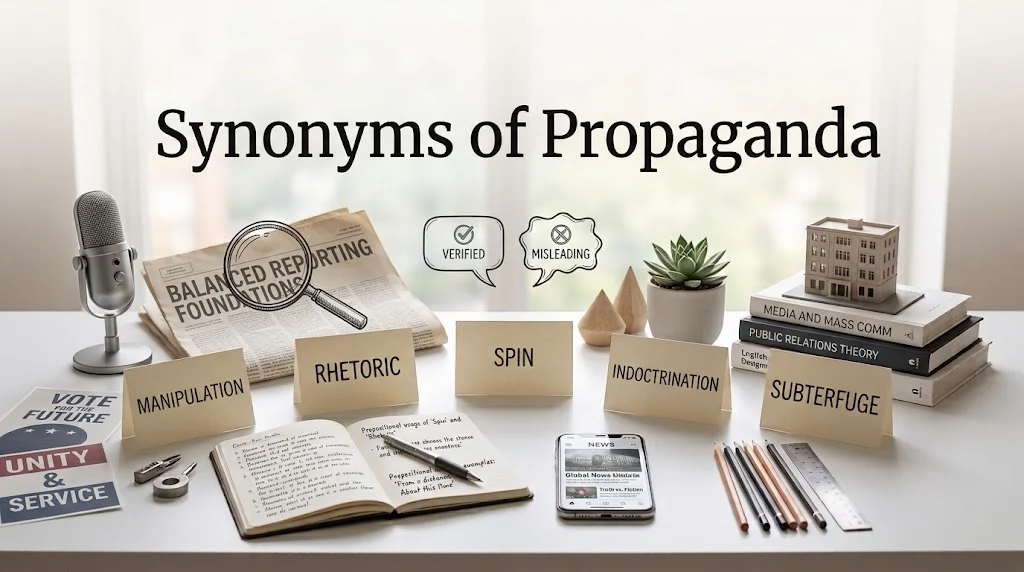
Propaganda is information designed to influence opinions, often through selective or misleading claims. Alternatives include publicity, indoctrination, spin, and disinformation.
When discussing politics, advertising, or news, choosing the right word can help readers understand how a message influences public opinion. Some messages share facts, while others present selected information to encourage a particular belief.
Propaganda generally involves communication designed to shape attitudes or behavior, often by presenting information in a one sided or misleading way. It can appear in speeches, posters, social media campaigns, advertisements, and public announcements.
Learning the synonyms of propaganda helps writers explain different persuasive techniques more accurately. Words such as persuasion, indoctrination, and disinformation have different meanings, so choosing the right alternative depends on the message and its purpose.
The following list includes 50 related words and expressions, each with a short meaning and two examples. These alternatives can help students, English learners, teachers, and writers discuss communication with greater clarity.
1. Publicity
Short Meaning: Information shared publicly to attract attention to a person, product, event, or cause.
Example 1: The campaign received widespread publicity before the national election.
Example 2: The company used positive publicity to promote its new collection.
2. Indoctrination
Short Meaning: Teaching beliefs in a way that discourages questioning or independent thought.
Example 1: The documentary examined indoctrination in an isolated political movement.
Example 2: Education should encourage critical thinking rather than unquestioning indoctrination.
3. Disinformation
Short Meaning: Deliberately false information spread to deceive people or influence their decisions.
Example 1: Disinformation spread online before voters could verify the claims.
Example 2: The company faced criticism for distributing disinformation about a competitor.
4. Misinformation
Short Meaning: False or inaccurate information shared regardless of whether the sender intends to deceive.
Example 1: Misinformation about the storm caused confusion among local residents.
Example 2: Teachers showed students how to identify misinformation on social media.
5. Spin
Short Meaning: A selective presentation of facts designed to make an event appear more favorable.
Example 1: The spokesperson used political spin to defend the unpopular decision.
Example 2: Clever marketing spin made the product launch sound more successful.
6. Persuasion
Short Meaning: Communication intended to convince someone to accept an idea or take action.
Example 1: Her speech relied on persuasion rather than threats or pressure.
Example 2: Effective persuasion helped the charity attract new supporters.
7. Manipulation
Short Meaning: Influencing people unfairly by exploiting emotions, information, or personal weaknesses.
Example 1: The report exposed the manipulation behind the misleading campaign.
Example 2: Emotional manipulation can damage trust between friends and colleagues.
8. Advocacy
Short Meaning: Public support for a cause, policy, belief, or group.
Example 1: Environmental advocacy encouraged residents to protect the local forest.
Example 2: Her advocacy for accessible education attracted national attention.
9. Agitation
Short Meaning: Efforts to stir public concern or encourage people to support a particular cause.
Example 1: Political agitation increased tensions during the public demonstration.
Example 2: The organizers used peaceful agitation to demand workplace reforms.
10. Indoctrinating rhetoric
Short Meaning: Language designed to establish beliefs while discouraging independent examination.
Example 1: The historian analyzed the indoctrinating rhetoric used in official speeches.
Example 2: Students learned to question indoctrinating rhetoric in political discussions.
11. Political messaging
Short Meaning: Communication designed to influence public attitudes toward political leaders, parties, or policies.
Example 1: Political messaging shaped the candidates’ television advertisements.
Example 2: Researchers studied political messaging during the election campaign.
12. Political rhetoric
Short Meaning: Language used by political figures to promote positions and influence public opinion.
Example 1: The candidate’s political rhetoric appealed to frustrated voters.
Example 2: Careful analysis revealed the emotional techniques in political rhetoric.
13. Public relations
Short Meaning: Planned communication intended to shape an organization’s public image and relationships.
Example 1: The firm hired public relations specialists after the product recall.
Example 2: Ethical public relations depends on accurate information and transparency.
14. Promotional messaging
Short Meaning: Communication intended to attract attention and encourage interest in an offer or idea.
Example 1: Promotional messaging highlighted the benefits of the new learning platform.
Example 2: Customers questioned the promotional messaging surrounding the expensive subscription.
15. Advertising
Short Meaning: Paid communication designed to promote products, services, brands, or ideas.
Example 1: The advertising campaign presented the new phone as essential for students.
Example 2: Misleading advertising can create unrealistic expectations among customers.
16. Advocacy campaign
Short Meaning: An organized effort to gain support for a social, political, or environmental cause.
Example 1: The advocacy campaign encouraged safer roads around local schools.
Example 2: Volunteers launched an advocacy campaign for affordable public transport.
17. Public persuasion
Short Meaning: Attempts to influence the opinions or behavior of a large audience.
Example 1: Public persuasion played a central role in the health awareness campaign.
Example 2: The speech relied on public persuasion to encourage recycling.
18. Ideological messaging
Short Meaning: Communication that promotes a particular set of political, social, or moral beliefs.
Example 1: The researcher examined ideological messaging in campaign posters.
Example 2: Ideological messaging influenced how viewers interpreted the historical documentary.
19. Promotional propaganda
Short Meaning: Persuasive promotional communication that selectively presents information to encourage support.
Example 1: The exhibition explored promotional propaganda used to sell wartime products.
Example 2: Consumers questioned the promotional propaganda surrounding the luxury brand.
20. Publicity campaign
Short Meaning: An organized series of communications designed to attract attention or shape public perception.
Example 1: The museum launched a publicity campaign before opening its new gallery.
Example 2: A publicity campaign helped the charity reach potential donors.
21. Indoctrination campaign
Short Meaning: An organized effort to establish particular beliefs while discouraging independent judgment.
Example 1: The investigation documented an indoctrination campaign within the extremist organization.
Example 2: The lesson explained how an indoctrination campaign can influence young audiences.
22. Information warfare
Short Meaning: Strategic use of information to weaken opponents or influence public understanding during a conflict.
Example 1: The report examined information warfare during the international dispute.
Example 2: False online stories became tools of information warfare.
23. Psychological operations
Short Meaning: Planned communication activities intended to influence the emotions, attitudes, or behavior of selected audiences.
Example 1: The book explored psychological operations used during historical conflicts.
Example 2: Analysts studied psychological operations aimed at weakening public confidence.
24. Influence campaign
Short Meaning: A coordinated effort to change public attitudes, beliefs, or decisions.
Example 1: Investigators uncovered an influence campaign targeting online voters.
Example 2: The nonprofit organized an influence campaign supporting cleaner waterways.
25. Image management
Short Meaning: Actions taken to control how a person, organization, or event appears to others.
Example 1: The executive focused on image management after the investigation.
Example 2: Effective image management helped the artist present a consistent public identity.
26. Whitewashing
Short Meaning: Hiding unpleasant facts or presenting wrongdoing in a misleadingly favorable way.
Example 1: Critics accused the company of whitewashing its environmental record.
Example 2: The film faced complaints about whitewashing the historical events.
27. Censorship
Short Meaning: Suppressing or restricting information, expression, or media that authorities oppose.
Example 1: Censorship prevented journalists from reporting the full story.
Example 2: The novel explores censorship under an authoritarian government.
28. Concealment
Short Meaning: The act of hiding facts that might change how people understand a situation.
Example 1: Concealment of financial losses damaged the organization’s credibility.
Example 2: The investigation revealed concealment of important safety information.
29. Deception
Short Meaning: Deliberately misleading someone through false statements, actions, or carefully hidden facts.
Example 1: The advertisement relied on deception about the product’s actual performance.
Example 2: Deception during negotiations destroyed trust between the business partners.
30. Falsehood
Short Meaning: A statement or claim that is untrue.
Example 1: The journalist corrected the falsehood before publishing the article.
Example 2: Repeating a falsehood does not make it a reliable fact.
31. Fabrication
Short Meaning: An invented story, claim, or piece of information presented as genuine.
Example 1: The investigation exposed the fabrication behind the dramatic news report.
Example 2: The company denied the fabrication circulated about its new technology.
32. Fearmongering
Short Meaning: Deliberately exaggerating dangers to create fear and influence people’s reactions.
Example 1: The speaker was criticized for fearmongering about immigration.
Example 2: Responsible reporting explains risks without resorting to fearmongering.
33. Scaremongering
Short Meaning: Spreading alarming claims to frighten people, often without sufficient evidence.
Example 1: The newspaper rejected scaremongering about the harmless new policy.
Example 2: Scaremongering about technology discouraged some families from trying digital learning.
34. Exploitation
Short Meaning: Taking unfair advantage of people’s fears, needs, or weaknesses for personal benefit.
Example 1: The investigation exposed the exploitation of vulnerable customers.
Example 2: Exploitation of public anxiety helped the dishonest seller increase profits.
35. Brainwashing
Short Meaning: Strong psychological influence intended to change someone’s beliefs through pressure or repeated messaging.
Example 1: The film explored allegations of brainwashing within the closed community.
Example 2: Critics described the relentless messaging as an attempt at brainwashing.
36. Indoctrinating message
Short Meaning: A communication that encourages fixed beliefs while discouraging questions or opposing evidence.
Example 1: The teacher asked students to analyze the indoctrinating message carefully.
Example 2: The group repeated an indoctrinating message during every meeting.
37. One sided reporting
Short Meaning: Coverage that presents one viewpoint while ignoring important opposing evidence or perspectives.
Example 1: One sided reporting gave readers an incomplete picture of the dispute.
Example 2: The editor revised the article to correct its one sided reporting.
38. Biased reporting
Short Meaning: News coverage shaped by unfair preferences rather than balanced treatment of evidence.
Example 1: Biased reporting influenced public reactions to the court case.
Example 2: Readers compared several outlets to identify biased reporting.
39. Selective reporting
Short Meaning: Choosing certain facts for publication while leaving out other relevant information.
Example 1: Selective reporting made the research findings appear more convincing than they were.
Example 2: The committee criticized selective reporting in the annual review.
40. Distortion
Short Meaning: Changing or presenting information in a way that creates a misleading impression.
Example 1: The headline contained a distortion of the scientist’s original statement.
Example 2: Distortion of historical facts can mislead younger readers.
41. Exaggeration
Short Meaning: Describing something as greater, worse, or more important than the facts support.
Example 1: The advertisement relied on exaggeration to attract customers.
Example 2: Exaggeration weakened the speaker’s argument during the debate.
42. Misrepresentation
Short Meaning: Presenting a person, event, or fact inaccurately so that others misunderstand it.
Example 1: The politician accused the newspaper of misrepresentation.
Example 2: Misrepresentation of the research results caused confusion among readers.
43. Rhetoric
Short Meaning: Language designed to influence an audience through persuasive expression and carefully chosen arguments.
Example 1: The candidate’s rhetoric appealed to voters seeking economic change.
Example 2: The teacher explained how rhetoric can shape public debate.
44. Agitprop
Short Meaning: Political communication combining agitation and propaganda to promote an ideological cause.
Example 1: The museum displayed agitprop posters from an earlier political movement.
Example 2: The documentary explored agitprop in revolutionary theater.
45. Public indoctrination
Short Meaning: Efforts to establish particular beliefs across a population through repeated authoritative messages.
Example 1: The historian studied public indoctrination under the former regime.
Example 2: The lesson examined how public indoctrination affected school curricula.
46. Persuasive messaging
Short Meaning: Communication designed to influence an audience’s beliefs, choices, or behavior.
Example 1: Persuasive messaging encouraged residents to conserve water during the drought.
Example 2: The marketing team tested persuasive messaging for its new product.
47. Reputation management
Short Meaning: Planned efforts to influence public perceptions of a person, company, or institution.
Example 1: Reputation management became a priority after the service failure.
Example 2: Honest reputation management requires clear responses to customer concerns.
48. Ideological persuasion
Short Meaning: Attempts to gain support for a particular belief system or political worldview.
Example 1: The speech relied on ideological persuasion to attract new supporters.
Example 2: The researcher examined ideological persuasion in historical publications.
49. Promotional spin
Short Meaning: Favorable framing of information intended to make a product, decision, or event look better.
Example 1: Promotional spin made the limited product launch sound revolutionary.
Example 2: Customers saw through the promotional spin in the company’s announcement.
50. Mass persuasion
Short Meaning: Communication intended to influence the beliefs or actions of a large audience.
Example 1: Radio broadcasts became an important tool for mass persuasion during wartime.
Example 2: Public health officials used mass persuasion to encourage vaccination.
Short Quiz
1: What is the main purpose of propaganda?
A. To record neutral facts only B. Influence opinions or behavior C. Explain mathematical rules D. To describe objects without interpretation
2: Which term describes deliberately false information spread to deceive people?
A. Publicity B. Advocacy C. Disinformation D. Persuasion
3: Which expression describes presenting selected facts to make a decision appear more favorable?
A. Spin B. Censorship C. Concealment D. Fabrication
4: Which term is most suitable for communication that encourages fixed beliefs while discouraging independent thought?
A. Public relations B. Indoctrination C. Advertising D. Reputation management
5: A news report includes only facts supporting one side of a dispute. What is the most suitable term?
A. Balanced reporting B. Selective reporting C. Open discussion D. Public advocacy
Quiz Answers
1. B. Propaganda is designed to influence how people think, feel, or act.
2. C. Disinformation involves deliberately spreading false information to mislead an audience.
3. A. Spin presents information selectively to make a person, decision, or event look more favorable.
4. B. Indoctrination promotes particular beliefs while discouraging independent examination.
5. B. Selective reporting highlights certain facts while leaving out other relevant information.
Frequently Asked Questions
1: What is the best synonym for propaganda?
Publicity or persuasive messaging may fit some contexts, while disinformation is more suitable when deliberate deception is involved.
2: What does propaganda mean in simple English?
It means communication designed to influence what people believe or how they respond to an issue.
3: What is a formal alternative to propaganda?
Ideological messaging is a formal alternative when communication promotes a particular political or social belief system.
4: Can propaganda be used in advertising and business?
Yes, promotional campaigns can use propagandistic techniques when they selectively present information to influence customers.
5: What is the opposite of propaganda?
Neutral, balanced, and evidence based communication can contrast with manipulative or one sided messaging.
Conclusion
Choosing the right alternative helps explain how messages influence audiences and shape public understanding. Some terms describe ordinary promotion or advocacy, while others suggest deliberate deception, emotional pressure, or the suppression of important facts.
When writing about media, politics, business, or history, consider the evidence before selecting a term. Precise vocabulary makes your argument more convincing and helps readers distinguish legitimate persuasion from misleading communication.

William Hayes is an American writer who contributes articles to SynonymCraft.com. He focuses on English vocabulary, synonyms, grammar, and word usage, helping readers improve their language skills through clear, simple, and practical explanations.









