Quick Answer
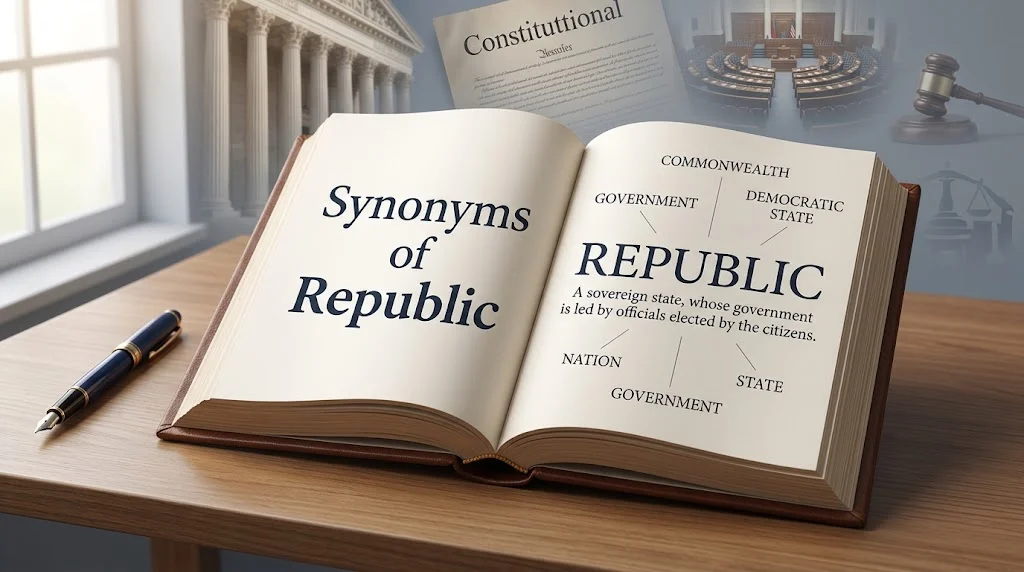
A republic is a state without a hereditary monarch. Strong alternatives include commonwealth, democracy, polity, and representative government.
Learning synonyms of republic gives you more ways to discuss government, citizenship, political systems, and independent states. Some alternatives are close in meaning, while others work only in particular political or historical contexts.
The right choice depends on what you want to emphasize. For example, the commonwealth may highlight a political community, while representative government focuses on elected officials.
This list presents 50 useful alternatives with simple meanings and natural examples. Students, teachers, writers, and English learners can use these terms to make political and historical writing clearer and more varied.
1. Commonwealth
Short Meaning: A political community or state, especially one organized around shared public interests.
Example 1: The ancient commonwealth valued public service and civic responsibility.
Example 2: Citizens gathered to discuss the future of their commonwealth.
2. Democracy
Short Meaning: A system in which citizens have a role in choosing their government.
Example 1: The country developed into a stable democracy after peaceful elections.
Example 2: Students studied how democracy gives citizens political participation.
3. Polity
Short Meaning: An organized political community or system of government.
Example 1: Historians examined the ancient polity and its governing institutions.
Example 2: The new polity created laws to protect citizens’ rights.
4. Representative Government
Short Meaning: A system where elected people make decisions on behalf of citizens.
Example 1: Representative government allows voters to choose lawmakers.
Example 2: The constitution established representative government throughout the new state.
5. Constitutional Government
Short Meaning: Government whose powers and limits are defined by a constitution.
Example 1: The nation adopted constitutional government after gaining independence.
Example 2: Constitutional government can limit the authority of political leaders.
6. Constitutional State
Short Meaning: A state governed according to an established constitution and legal framework.
Example 1: The constitutional state protected individual rights through written laws.
Example 2: Citizens expected the constitutional state to respect judicial decisions.
7. Sovereign State
Short Meaning: An independent political entity with authority over its territory and domestic affairs.
Example 1: The island became a sovereign state after a peaceful transition.
Example 2: Every sovereign state has responsibilities under international law.
8. Independent State
Short Meaning: A country that governs itself without being controlled by another country.
Example 1: The territory eventually became an independent state.
Example 2: An independent state can establish its own laws and institutions.
9. Self Governing State
Short Meaning: A state that manages its internal affairs through its own political institutions.
Example 1: The region became a self governing state after gaining greater autonomy.
Example 2: A self governing state can create policies suited to local needs.
10. Political Community
Short Meaning: A group of people organized around shared political institutions, laws, and responsibilities.
Example 1: The political community debated reforms during the national meeting.
Example 2: Citizens built a stronger political community through public participation.
11. Civic Community
Short Meaning: A community connected by shared citizenship, public duties, and common institutions.
Example 1: The civic community supported projects that benefited local residents.
Example 2: Schools helped strengthen the civic community through service activities.
12. Popular Government
Short Meaning: Government whose authority is based on the participation or consent of ordinary citizens.
Example 1: The constitution promoted popular government through regular elections.
Example 2: Popular government requires citizens to take an active interest in public affairs.
13. Elective Government
Short Meaning: A government in which public officials are selected through elections.
Example 1: The country replaced hereditary rule with elective government.
Example 2: Elective government gave citizens a greater voice in leadership.
14. Elected Government
Short Meaning: A government whose principal leaders or representatives are chosen by voters.
Example 1: The elected government introduced several economic reforms.
Example 2: Citizens expected the elected government to honor its campaign promises.
15. Government by Consent
Short Meaning: A political system based on the idea that legitimate authority comes from the people.
Example 1: The constitution emphasized government by consent rather than inherited authority.
Example 2: Government by consent became an important principle in the political debate.
16. Government of the People
Short Meaning: A form of government that places political authority in the hands of citizens.
Example 1: The new constitution promised government of the people.
Example 2: Government of the people depends on meaningful public participation.
17. People’s Government
Short Meaning: A government presented as representing the interests and authority of its population.
Example 1: The leaders described their administration as a people’s government.
Example 2: A people’s government must remain responsive to public concerns.
18. Free State
Short Meaning: An independent state, often emphasizing political freedom or self determination.
Example 1: The movement sought to establish a free state.
Example 2: Citizens celebrated the creation of their free state.
19. Democratic State
Short Meaning: A state where citizens participate in political life and choose public leaders.
Example 1: The constitution established the country as a democratic state.
Example 2: A democratic state usually provides mechanisms for peaceful political change.
20. Civic State
Short Meaning: A state understood through the shared rights and responsibilities of its citizens.
Example 1: The civic state encouraged citizens to participate in local government.
Example 2: Public education played a major role in building the civic state.
21. Commonwealth State
Short Meaning: A state described as a political community organized around shared public interests.
Example 1: The constitution described the country as a commonwealth state.
Example 2: Public institutions helped strengthen the commonwealth state.
22. Democratic Commonwealth
Short Meaning: A political community combining common public interests with democratic institutions.
Example 1: The leaders envisioned a democratic commonwealth based on equal citizenship.
Example 2: Education became central to the democratic commonwealth.
23. Civic Commonwealth
Short Meaning: A political community emphasizing citizenship, public duties, and shared welfare.
Example 1: The civic commonwealth encouraged residents to participate in public life.
Example 2: Public parks became symbols of the civic commonwealth.
24. Federal Republic
Short Meaning: A republic in which political power is divided between national and regional governments.
Example 1: The federal republic gave substantial authority to its provinces.
Example 2: Each region within the federal republic had its own elected assembly.
25. Parliamentary Republic
Short Meaning: A republic where an elected parliament plays the central role in forming government.
Example 1: The parliamentary republic selected its prime minister through parliamentary politics.
Example 2: Coalition building is common in a parliamentary republic.
26. Presidential Republic
Short Meaning: A republic where a president serves as the principal elected executive.
Example 1: The presidential republic holds national elections every four years.
Example 2: The president of the presidential republic appoints senior officials.
27. Semi Presidential Republic
Short Meaning: A republic combining an elected president with a prime minister and parliament.
Example 1: The semi presidential republic divides executive responsibilities between two offices.
Example 2: Political cooperation is important in a semi presidential republic.
28. Federal State
Short Meaning: A state where constitutional powers are shared between national and regional authorities.
Example 1: The federal state allows regions to manage several domestic matters.
Example 2: Tax policy can involve both levels of government in a federal state.
29. Union State
Short Meaning: A state formed through the political union of separate territories or regions.
Example 1: The union state created common institutions for its member regions.
Example 2: Representatives debated how power should be divided within the union state.
30. Nation State
Short Meaning: A state whose political identity is strongly connected with a shared national community.
Example 1: The nation state developed a common legal and cultural identity.
Example 2: National symbols helped strengthen the identity of the nation state.
31. Independent Republic
Short Meaning: A self ruling republic that exercises political authority without foreign control.
Example 1: The territory became an independent republic after years of negotiation.
Example 2: The independent republic created new diplomatic relationships.
32. Democratic Republic
Short Meaning: A republic that formally emphasizes democratic institutions and citizen participation.
Example 1: The country adopted the name Democratic Republic after political reforms.
Example 2: The democratic republic expanded voting rights for its citizens.
33. Secular Republic
Short Meaning: A republic whose government operates separately from religious institutions.
Example 1: The constitution established the country as a secular republic.
Example 2: A secular republic may protect people with different religious beliefs.
34. Parliamentary State
Short Meaning: A state where parliament has a major role in choosing and overseeing government.
Example 1: The parliamentary state depends heavily on legislative cooperation.
Example 2: Voters elected representatives to serve in the parliamentary state.
35. Constitutional Republic
Short Meaning: A republic whose government operates within constitutional limits and legal rules.
Example 1: The constitutional republic protects political rights through its founding document.
Example 2: Courts help maintain the legal balance within a constitutional republic.
36. Popular Republic
Short Meaning: A republic described as deriving political authority from the population.
Example 1: The leaders presented the new government as a popular republic.
Example 2: Public participation became a central principle of the popular republic.
37. Free Republic
Short Meaning: A republic emphasizing independence, political liberty, or freedom from hereditary rule.
Example 1: Citizens hoped to build a free republic based on equal rights.
Example 2: The movement called for a free republic with elected leaders.
38. Citizen State
Short Meaning: A state viewed primarily through the political rights and duties of its citizens.
Example 1: The citizen state encouraged residents to understand their legal responsibilities.
Example 2: Public service helped young people contribute to the citizen state.
39. Civic Polity
Short Meaning: An organized political community centered on citizenship and public institutions.
Example 1: The civic polity developed new rules for local participation.
Example 2: Scholars examined how citizenship shaped the ancient civic polity.
40. Representative State
Short Meaning: A state where citizens elect representatives to exercise political authority.
Example 1: The representative state held regular legislative elections.
Example 2: Citizens expected their representatives to defend public interests.
41. Electoral State
Short Meaning: A state in which elections play a significant role in selecting political authorities.
Example 1: The electoral state introduced stronger protections for voters.
Example 2: Political parties competed for influence within the electoral state.
42. Sovereign Republic
Short Meaning: A self ruling republic with recognized authority over its territory.
Example 1: The sovereign republic established its own diplomatic missions abroad.
Example 2: A sovereign republic can negotiate agreements with other countries.
43. Independent Republic State
Short Meaning: A self governing political state organized without a hereditary monarch.
Example 1: The independent republic state created new national institutions.
Example 2: Citizens celebrated the formation of their independent republic state.
44. Republican State
Short Meaning: A state organized according to republican principles rather than hereditary monarchy.
Example 1: The constitution established a republican state with elected institutions.
Example 2: Public office in the republican state was not inherited.
45. Representative Polity
Short Meaning: A political community where citizens govern through elected representatives.
Example 1: The representative polity gave citizens a formal role in national elections.
Example 2: Parliament became the central institution of the representative polity.
46. Constitutional Polity
Short Meaning: A political community whose governing authority is structured by constitutional rules.
Example 1: The constitutional polity limited government power through established laws.
Example 2: Courts played an important role in protecting the constitutional polity.
47. Independent Commonwealth
Short Meaning: A self governing political community emphasizing shared public interests.
Example 1: The independent commonwealth developed its own institutions after separation.
Example 2: Citizens worked together to strengthen the independent commonwealth.
48. Self Governing Republic
Short Meaning: A republic that manages its political affairs through its own institutions.
Example 1: The self governing republic created an elected national assembly.
Example 2: Local leaders helped the self governing republic develop effective policies.
49. Nonmonarchical State
Short Meaning: A state whose highest political authority is not based on hereditary monarchy.
Example 1: The constitution created a nonmonarchical state with elected leadership.
Example 2: Citizens debated how the nonmonarchical state should distribute political power.
50. Popular Commonwealth
Short Meaning: A political community emphasizing public participation, shared interests, and citizen authority.
Example 1: The founders imagined a popular commonwealth built around civic participation.
Example 2: Public education supported the ideals of the popular commonwealth.
Short Quiz
1: Which statement best explains the basic meaning of a republic?
A. A state ruled by a hereditary monarch
B. A state without a hereditary monarch
C. A territory controlled by another country
D. A community without political institutions
2: Which term best fits a government where citizens choose representatives?
A. Hereditary government
B. Representative government
C. Absolute monarchy
D. Colonial government
3: Which term describes a republic where power is shared between national and regional governments?
A. Federal republic
B. Parliamentary state
C. Civic community
D. Free state
4: Which alternative is most suitable for formal writing about a government limited by a constitution?
A. Constitutional government
B. People’s government
C. Free state
D. Popular commonwealth
5: A country has an elected president who serves as its main executive leader; which term fits best?
A. Parliamentary republic
B. Presidential republic
C. Constitutional state
D. Civic polity
Quiz Answers
B. A republic is a state in which political authority does not depend on a hereditary monarch.
B. Representative government describes a system where elected people act on behalf of citizens.
A. A federal republic divides constitutional authority between national and regional governments.
A. Constitutional government highlights the role of constitutional limits and established legal rules.
B. A presidential republic has an elected president serving as the principal executive authority.
Frequently Asked Questions
1: What is the best synonym for republic?
Commonwealth is often the closest general alternative, although its exact meaning depends on context.
2: What is the simple meaning of republic?
A republic is a state where political authority is not based on a hereditary monarch.
3: What is a formal alternative to republic?
Constitutional state is a useful formal alternative when the emphasis is on constitutional government.
4: Can republic describe objects or situations?
No, the term normally describes a political state or organized political community rather than ordinary objects or situations.
5: What is the opposite of republic?
Monarchy is the clearest contrasting form when political authority is centered on a hereditary monarch.
Conclusion
Choosing among political terms requires attention to the exact idea you want to express. Some alternatives emphasize elections, others highlight constitutional limits, independence, citizenship, or the structure of government.
The best choice depends on context, tone, and meaning. A history essay may need a precise constitutional term, while general writing may benefit from a broader expression such as commonwealth or political community.

William Hayes is an American writer who contributes articles to SynonymCraft.com. He focuses on English vocabulary, synonyms, grammar, and word usage, helping readers improve their language skills through clear, simple, and practical explanations.










6 thoughts on “Synonyms for Republic: Common Alternatives Explained for 2026”