Quick Answer
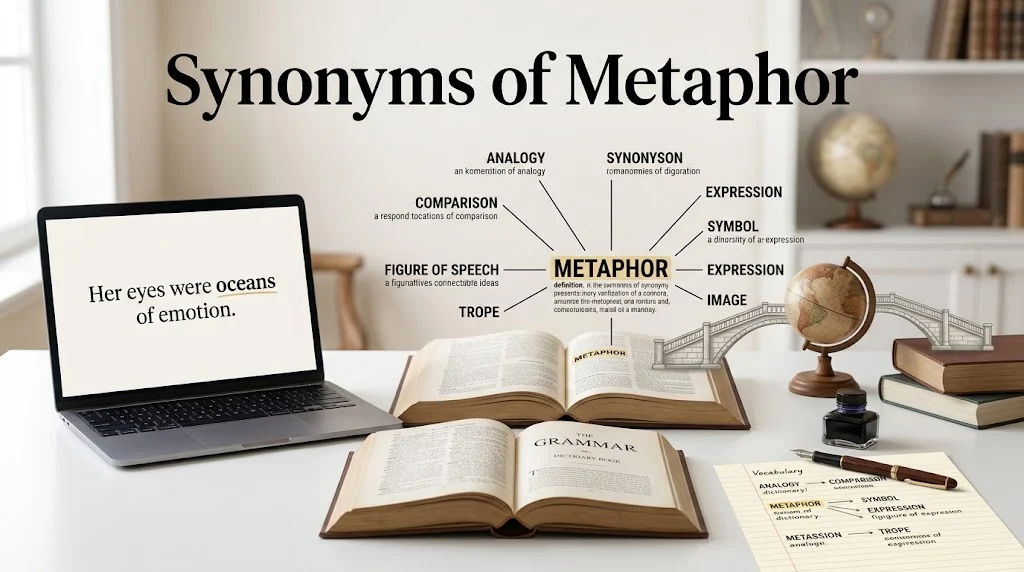
A metaphor describes one thing through another idea; alternatives include analogy, comparison, symbol, image, allegory, and figure of speech.
A student describing a difficult exam might call it a mountain, while a novelist may describe hope as a light. These comparisons give ordinary ideas a stronger emotional or visual quality.
The word describes a figure of speech that connects one thing with another to suggest a shared quality. Writers use this technique to make abstract thoughts easier to picture, memorable, or emotionally powerful.
Learning synonyms of metaphor can help you discuss literature more precisely and avoid repeating the same expression. The list below includes related literary terms, forms of comparison, symbolic expressions, and useful alternatives, with simple meanings and practical examples.
1. Analogy
Short Meaning: A comparison that explains an unfamiliar idea by connecting it with something easier to understand.
Example 1: The teacher used an analogy between the brain and a powerful computer.
Example 2: Her analogy compared teamwork to pieces working together inside a machine.
2. Comparison
Short Meaning: An expression that places two different things together to highlight a shared quality.
Example 1: The poem makes a comparison between childhood and a passing season.
Example 2: His comparison of business growth with gardening made the strategy memorable.
3. Symbol
Short Meaning: An object, action, or image that represents a deeper idea or feeling.
Example 1: The dove serves as a symbol of peace throughout the novel.
Example 2: A wedding ring can become a symbol of lasting commitment.
4. Allegory
Short Meaning: A story or description in which characters and events represent broader ideas.
Example 1: The novel is an allegory about power, freedom, and human responsibility.
Example 2: The artist created an allegory showing society as a damaged building.
5. Image
Short Meaning: A word or description that creates a strong picture or impression in the reader’s mind.
Example 1: The poet creates a vivid image of winter covering the silent village.
Example 2: Her description of silver rain gave the scene a beautiful image.
6. Figure Of Speech
Short Meaning: A creative use of language that communicates more than the literal wording suggests.
Example 1: The teacher explained how this figure of speech changes the sentence’s meaning.
Example 2: Writers often use a figure of speech to make descriptions more memorable.
7. Figurative Expression
Short Meaning: Language that communicates an idea through imagination rather than direct literal wording.
Example 1: “A sea of faces” is a figurative expression describing a large crowd.
Example 2: The author used a figurative expression to portray fear as a shadow.
8. Figurative Language
Short Meaning: Creative language that presents ideas through imagery, comparison, symbolism, or other indirect techniques.
Example 1: Figurative language makes the poem’s emotional message more vivid.
Example 2: Students studied figurative language in several famous short stories.
9. Simile
Short Meaning: A direct comparison between unlike things, usually introduced with “like” or “as.”
Example 1: The writer describes her smile like sunlight breaking through clouds.
Example 2: The student used a simile to describe the machine as quiet as a cat.
10. Personification
Short Meaning: A literary technique that gives human qualities, actions, or feelings to nonhuman things.
Example 1: The poem says the angry storm marched across the valley.
Example 2: The old house seemed to whisper whenever the wind blew.
11. Symbolism
Short Meaning: The use of objects, colors, actions, or images to suggest deeper meanings.
Example 1: The novel’s symbolism connects darkness with uncertainty and fear.
Example 2: Gold symbolism in the artwork suggests wealth and spiritual value.
12. Emblem
Short Meaning: A recognizable object or image that represents a particular quality, group, or idea.
Example 1: The crown became an emblem of authority throughout the historical story.
Example 2: The oak leaf served as an emblem of strength on the badge.
13. Motif
Short Meaning: A repeated image, idea, or element that supports an important theme.
Example 1: Water is a recurring motif representing change throughout the novel.
Example 2: Birds form a motif that appears whenever the character dreams of freedom.
14. Representation
Short Meaning: Something that stands for or portrays another idea, quality, person, or experience.
Example 1: The broken mirror becomes a representation of the character’s divided identity.
Example 2: The sculpture offers a representation of human strength and endurance.
15. Sign
Short Meaning: Something that points toward or communicates a particular meaning or idea.
Example 1: The rising smoke was a sign that something had caught fire.
Example 2: In the story, the closed door becomes a sign of isolation.
16. Metonymy
Short Meaning: A figure of speech that names something through a closely associated term.
Example 1: The newsroom reported that “the crown” had issued a statement.
Example 2: “The board” can refer to the people who govern a company.
17. Synecdoche
Short Meaning: A figure of speech that uses a part to represent the whole or the whole for part.
Example 1: The phrase “all hands” uses synecdoche to mean all available workers.
Example 2: In the story, “wheels” refers to a complete car.
18. Idiom
Short Meaning: A familiar expression whose intended meaning differs from its literal wording.
Example 1: “Break the ice” is an idiom about making people feel comfortable.
Example 2: She used the idiom “hit the books” when discussing exam preparation.
19. Expression
Short Meaning: A particular way of communicating an idea, feeling, or thought through language.
Example 1: “Time is slipping away” is a memorable expression of urgency.
Example 2: His expression of gratitude appeared in a heartfelt speech.
20. Phrase
Short Meaning: A group of words that can communicate a figurative or special idea.
Example 1: “A broken heart” is a phrase often associated with emotional pain.
Example 2: The novelist created a striking phrase to describe the crowded city.
21. Word Picture
Short Meaning: A verbal description that helps readers imagine a person, place, object, or experience.
Example 1: The poet paints a word picture of a quiet forest at dawn.
Example 2: Her travel essay creates a vivid word picture of the ancient city.
22. Verbal Image
Short Meaning: Language that creates a mental picture while suggesting qualities beyond literal description.
Example 1: “A river of traffic” creates a strong verbal image of moving vehicles.
Example 2: The novelist uses a verbal image to portray loneliness as an empty room.
23. Literary Device
Short Meaning: A deliberate writing technique that creates meaning, emotion, emphasis, or artistic effect.
Example 1: The metaphor is an important literary device in the opening chapter.
Example 2: Repetition is another literary device that gives the speech greater force.
24. Rhetorical Device
Short Meaning: A language technique designed to influence, emphasize, persuade, or engage an audience.
Example 1: The speaker used a rhetorical device to make the argument more memorable.
Example 2: A carefully chosen comparison can work as an effective rhetorical device.
25. Poetic Device
Short Meaning: A technique poets use to create imagery, rhythm, emotion, or deeper meaning.
Example 1: The poet uses several poetic devices to strengthen the emotional tone.
Example 2: Students identified a poetic device that connected nature with human emotion.
26. Literary Comparison
Short Meaning: A comparison in literature that connects separate ideas to reveal a meaningful relationship.
Example 1: The literary comparison links the character’s journey with the changing seasons.
Example 2: Her essay explores a literary comparison between memory and an old photograph.
27. Figurative Comparison
Short Meaning: A comparison that goes beyond literal facts to create an imaginative connection.
Example 1: Calling knowledge a key is a figurative comparison about discovery.
Example 2: The speech uses a figurative comparison between leadership and navigation.
28. Extended Comparison
Short Meaning: A comparison developed across several sentences, lines, or parts of a longer work.
Example 1: The poem develops an extended comparison between life and a long journey.
Example 2: Her essay builds an extended comparison between learning and building a house.
29. Conceptual Image
Short Meaning: A mental picture used to communicate an abstract idea in a more understandable form.
Example 1: The lecturer introduced a conceptual image of knowledge as a growing tree.
Example 2: The novel presents time as a river through a recurring conceptual image.
30. Mental Image
Short Meaning: A picture formed in the mind through descriptive or imaginative language.
Example 1: The author’s description created a mental image of the abandoned castle.
Example 2: That phrase gives readers a mental image of endless possibilities.
31. Imaginative Comparison
Short Meaning: A creative connection between unlike things that reveals a shared quality or feeling.
Example 1: The poem makes an imaginative comparison between sadness and falling snow.
Example 2: His speech uses an imaginative comparison between teamwork and an orchestra.
32. Evocative Image
Short Meaning: A powerful image that brings a particular feeling, memory, atmosphere, or idea to mind.
Example 1: The writer’s evocative image of rain creates a feeling of loneliness.
Example 2: An evocative image of autumn gives the advertisement a warm mood.
33. Symbolic Image
Short Meaning: An image that carries an additional meaning beyond its ordinary appearance.
Example 1: The locked gate becomes a symbolic image of lost opportunity.
Example 2: A burning candle serves as a symbolic image of hope.
34. Symbolic Representation
Short Meaning: Something presented as a visible or recognizable form of a deeper concept.
Example 1: The statue is a symbolic representation of justice and fairness.
Example 2: The empty chair becomes a symbolic representation of absence.
35. Figurative Image
Short Meaning: An imaginative picture that suggests an idea beyond the object’s literal identity.
Example 1: The poem presents the moon as a figurative image of loneliness.
Example 2: The writer uses a figurative image of fire to suggest ambition.
36. Abstract Representation
Short Meaning: A representation that gives form to an idea, feeling, quality, or concept.
Example 1: The painting offers an abstract representation of freedom.
Example 2: The sculpture provides an abstract representation of movement and energy.
37. Creative Comparison
Short Meaning: An original connection between different things used to make an idea vivid.
Example 1: Her creative comparison described education as opening a series of doors.
Example 2: The campaign used a creative comparison between clean energy and fresh air.
38. Descriptive Image
Short Meaning: A carefully chosen description that helps readers visualize a scene, object, or experience.
Example 1: The descriptive image of the garden makes the setting feel peaceful.
Example 2: His descriptive image of the old factory adds atmosphere to the story.
39. Implied Comparison
Short Meaning: A comparison suggested indirectly rather than introduced with an explicit comparison word.
Example 1: Calling the classroom a battlefield creates an implied comparison about competition.
Example 2: Her speech presents the workplace as a garden through an implied comparison.
40. Direct Comparison
Short Meaning: A clear connection between two things that highlights a particular similarity.
Example 1: The essay makes a direct comparison between traditional and modern architecture.
Example 2: His presentation makes a direct comparison between two business models.
41. Indirect Comparison
Short Meaning: A suggested relationship between two things that readers understand without an explicit statement.
Example 1: The story creates an indirect comparison between aging and changing seasons.
Example 2: Her artwork makes an indirect comparison between technology and isolation.
42. Associative Image
Short Meaning: An image that gains meaning by connecting one idea with another familiar concept.
Example 1: The empty road becomes an associative image for uncertainty.
Example 2: The designer chose an associative image of roots to suggest family history.
43. Suggestive Image
Short Meaning: An image that hints at an emotion, idea, or meaning without explaining it directly.
Example 1: The closed window is a suggestive image of separation.
Example 2: A fading photograph becomes a suggestive image of forgotten memories.
44. Evocation
Short Meaning: Language or imagery that brings a particular feeling, memory, or idea into awareness.
Example 1: The poem’s evocation of childhood makes its final scene deeply emotional.
Example 2: The painting creates an evocation of summer through light and color.
45. Allusion
Short Meaning: An indirect reference to a familiar person, event, work, place, or cultural idea.
Example 1: The novel contains an allusion to a famous Greek myth.
Example 2: Her speech included an allusion to Shakespeare’s most famous tragedy.
46. Hyperbole
Short Meaning: Deliberate exaggeration used to create emphasis, humor, excitement, or emotional force.
Example 1: Saying “I have told you a million times” is common hyperbole.
Example 2: The advertisement uses hyperbole to make the product sound extraordinary.
47. Irony
Short Meaning: A contrast between expected meaning and actual meaning, often creating humor or emphasis.
Example 1: The story uses irony when the expert makes the simplest mistake.
Example 2: Her ironic comment revealed how frustrated she was with the situation.
48. Parable
Short Meaning: A short story that teaches a moral, spiritual, or practical lesson through events.
Example 1: The teacher shared a parable about honesty before the class discussion.
Example 2: The ancient parable teaches readers to value kindness over wealth.
49. Archetype
Short Meaning: A familiar character, image, pattern, or situation that appears across many stories and cultures.
Example 1: The wise mentor is a common archetype in adventure stories.
Example 2: The journey into an unknown land is a familiar archetype in literature.
50. Trope
Short Meaning: A recurring literary idea, image, theme, or storytelling pattern recognized by readers.
Example 1: The story uses the hero’s journey as a familiar trope.
Example 2: The writer deliberately changes a common romantic trope for comic effect.
Short Quiz
1: What does a metaphor primarily do?
A. Gives exact scientific measurements
B. Connects one thing with another to suggest a shared quality
C. Lists events in chronological order
D. Provides a dictionary definition
2: Which term describes a comparison using “like” or “as”?
A. Allegory
B. Symbolism
C. Simile
D. Metonymy
3: Which literary technique gives human qualities to nonhuman things?
A. Personification
B. Allusion
C. Hyperbole
D. Motif
4: Which term is most suitable for a story in which characters and events represent broader ideas?
A. Phrase
B. Allegory
C. Sign
D. Expression
5: A writer repeatedly uses birds to represent freedom throughout a novel; what is this repeated element called?
A. Motif
B. Idiom
C. Hyperbole
D. Metonymy
Quiz Answers
B. A metaphor connects different things to communicate a shared quality or deeper idea.
C. A simile makes a direct comparison using words such as “like” or “as.”
A. Personification gives human traits, actions, or emotions to nonhuman subjects.
B. An allegory uses a story or description to represent wider ideas.
A. A motif is a recurring image, idea, or element that supports a theme.
Frequently Asked Questions
1: What is the best synonym for metaphor?
Analogy is often the closest broad alternative when the focus is on explaining one idea through another.
2: What is the simple meaning of metaphor?
A metaphor describes one thing by presenting it as another thing to suggest a meaningful similarity.
3: What is a formal alternative to metaphor?
Figurative expression is a useful formal term when discussing imaginative language in academic writing.
4: Can a metaphor describe objects and situations?
Yes, it can connect physical objects, abstract ideas, experiences, emotions, situations, and qualities.
5: What is the opposite of metaphor?
There is no exact opposite, but literal language presents meaning directly without an imaginative comparison.
Conclusion
Knowing different terms related to figurative comparison helps readers discuss literature and writing with greater precision. Some alternatives describe specific techniques, while others focus on symbols, recurring ideas, indirect references, or vivid mental pictures.
The right choice depends on context, tone, and the exact relationship being discussed. A literary analysis may require a precise technical term, while everyday writing may benefit from a simpler expression.

Jackson Turner is an American writer who contributes educational and informative articles to SynonymCraft.com. He focuses on English vocabulary, synonyms, grammar, spelling, and word usage, helping readers understand language concepts in a simple and practical way. Through his clear and reader friendly writing,









