Quick Answer
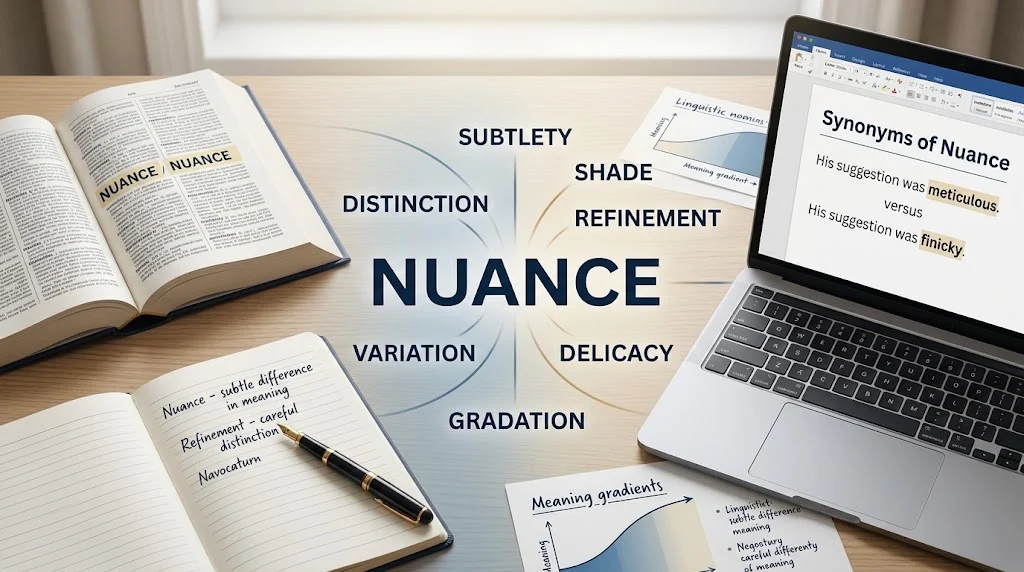
A nuance is a subtle difference or shade of meaning. Strong alternatives include subtlety, distinction, refinement, variation, and implication.
A careful editor may change one word because it creates a slightly different feeling. That small change can add meaning, emotion, or precision to a sentence.
The synonyms of nuance are useful when you want to describe fine differences that are easy to overlook. The word can apply to language, art, emotions, opinions, design, relationships, and technical ideas.
Choosing the right alternative helps your writing sound more precise. A novelist may need a word for an emotional shade, while a scientist may need one for a small variation in results. The 50 alternatives below cover these different uses, with simple meanings and practical examples.
1. Subtlety
Short Meaning: A small quality or difference that is not immediately obvious.
Example 1: The painting gains its beauty from the subtlety of its lighting.
Example 2: Good teachers notice the subtlety in each student’s response.
2. Distinction
Short Meaning: A meaningful difference between two things that may initially seem similar.
Example 1: The professor explained the distinction between correlation and causation.
Example 2: Her speech showed a clear distinction between facts and opinions.
3. Refinement
Short Meaning: A small improvement that makes an idea, style, or product more precise.
Example 1: The designer added a final refinement to the necklace.
Example 2: Years of practice brought refinement to his writing style.
4. Shade
Short Meaning: A slight variation in meaning, feeling, color, or quality.
Example 1: Her answer contained a shade of disappointment.
Example 2: The artist selected a warmer shade for the bedroom walls.
5. Variation
Short Meaning: A small difference from another version, form, result, or condition.
Example 1: Researchers observed a slight variation in the test results.
Example 2: The recipe allows variation according to personal taste.
6. Gradation
Short Meaning: A gradual change from one level, condition, color, or quality to another.
Example 1: The mural uses a beautiful gradation from blue to violet.
Example 2: The lesson explained the gradation of political opinions.
7. Qualification
Short Meaning: An added condition or detail that makes a statement more precise.
Example 1: She added a qualification to her earlier statement.
Example 2: The contract includes an important qualification concerning payment.
8. Implication
Short Meaning: An indirect meaning or possible result suggested without being directly stated.
Example 1: His silence carried an implication that he disagreed.
Example 2: The report discussed the financial implications of the decision.
9. Connotation
Short Meaning: An associated feeling or idea that a word suggests beyond its basic meaning.
Example 1: The word has a negative connotation in formal discussions.
Example 2: Advertising often relies on the positive connotations of certain colors.
10. Undertone
Short Meaning: A quiet feeling or message present beneath the obvious meaning.
Example 1: There was an undertone of sadness in her cheerful letter.
Example 2: The conversation carried an undertone of tension throughout dinner.
11. Inflection
Short Meaning: A slight change in expression, voice, or meaning produced by delivery.
Example 1: His change in inflection made the question sound sarcastic.
Example 2: A gentle inflection can make instructions seem more friendly.
12. Difference
Short Meaning: A point at which two things are not exactly alike.
Example 1: The teacher highlighted the difference between formal and casual language.
Example 2: Even a small difference can change how a message feels.
13. Disparity
Short Meaning: A noticeable gap or inequality between two things being compared.
Example 1: The study revealed a disparity between reported income and spending.
Example 2: The architect considered the disparity between old and new buildings.
14. Contrast
Short Meaning: A clear difference that becomes noticeable when two things are compared.
Example 1: The contrast between the rooms creates a dramatic visual effect.
Example 2: Her calm response provided contrast to his angry reaction.
15. Delicacy
Short Meaning: A fine quality requiring careful attention because small changes affect its effect.
Example 1: The poem handles grief with remarkable delicacy.
Example 2: Diplomats discussed the delicate issue with great delicacy.
16. Fineness
Short Meaning: A high degree of precision, quality, or careful detail.
Example 1: The jeweler admired the fineness of the engraved bracelet.
Example 2: The manuscript shows remarkable fineness in its word choice.
17. Precision
Short Meaning: Exactness achieved by choosing or presenting information very carefully.
Example 1: Scientific writing depends on precision when describing experimental results.
Example 2: Her precision helped the team avoid a costly misunderstanding.
18. Specificity
Short Meaning: The quality of expressing an idea with exact and clearly defined details.
Example 1: The report needs greater specificity about the proposed changes.
Example 2: Specificity makes technical instructions easier for users to follow.
19. Exactness
Short Meaning: The quality of being completely accurate or closely matched to reality.
Example 1: The engineer checked the exactness of every measurement.
Example 2: Historical writing requires care and exactness when presenting dates.
20. Subdivision
Short Meaning: A smaller part created within a larger category, subject, or group.
Example 1: The architect created a subdivision within the larger floor plan.
Example 2: The textbook uses subdivision to organize several related concepts.
21. Fine Point
Short Meaning: A small but important detail that can affect understanding or judgment.
Example 1: The lawyer explained every fine point of the agreement.
Example 2: Students often miss a fine point when reading quickly.
22. Detail
Short Meaning: A particular feature that adds information, accuracy, or depth.
Example 1: The sculptor paid attention to every detail of the statue.
Example 2: One small detail changed the meaning of the story.
23. Element
Short Meaning: A particular part that contributes to the character or overall effect of something.
Example 1: Humor is an important element in the author’s storytelling.
Example 2: Texture became a central element of the interior design.
24. Feature
Short Meaning: A noticeable quality or characteristic that helps define something.
Example 1: The curved roof is a distinctive feature of the building.
Example 2: Patience is an important feature of her leadership style.
25. Aspect
Short Meaning: One particular part or side of a broader subject or situation.
Example 1: The course examines every aspect of environmental policy.
Example 2: Cost is only one aspect of choosing new software.
26. Dimension
Short Meaning: A particular side of an issue that adds depth to understanding.
Example 1: The novel introduces a psychological dimension to the mystery.
Example 2: The discussion included a cultural dimension that surprised everyone.
27. Facet
Short Meaning: One distinct part of a subject that reveals another way to understand it.
Example 1: Trust is an important facet of healthy relationships.
Example 2: The exhibition explored every facet of modern architecture.
28. Layer
Short Meaning: An underlying level of meaning, feeling, or structure within something larger.
Example 1: The short story contains a deeper layer of social criticism.
Example 2: The software adds another security layer to the platform.
29. Depth
Short Meaning: The presence of rich meaning, thought, or complexity beneath the surface.
Example 1: Her essay has surprising depth for such a short piece.
Example 2: The painting gains depth through carefully placed shadows.
30. Complexity
Short Meaning: The presence of many connected parts, factors, or meanings.
Example 1: The researcher explained the complexity of the biological process.
Example 2: Family relationships often contain unexpected complexity.
31. Intricacy
Short Meaning: A quality created by many closely connected parts or fine details.
Example 1: Visitors admired the intricacy of the carved wooden ceiling.
Example 2: The watchmaker carefully examined the intricacy of the mechanism.
32. Sophistication
Short Meaning: A high level of development, understanding, style, or technical quality.
Example 1: The software shows impressive sophistication for a small application.
Example 2: Her argument demonstrated sophistication without becoming difficult to understand.
33. Nuancedness
Short Meaning: The quality of containing fine differences instead of presenting ideas too simply.
Example 1: The article’s nuancedness makes its discussion of culture more convincing.
Example 2: Readers appreciated the nuancedness of the character’s emotions.
34. Modulation
Short Meaning: A controlled adjustment in tone, intensity, expression, or form.
Example 1: The singer used careful modulation to express changing emotions.
Example 2: Voice modulation helped the presenter keep the audience engaged.
35. Tone
Short Meaning: The emotional or attitudinal quality communicated through words, voice, or style.
Example 1: The email has a friendly tone despite its serious subject.
Example 2: Changing the tone made the announcement sound more respectful.
36. Timbre
Short Meaning: The distinctive quality of a voice or musical sound.
Example 1: The singer’s warm timbre gave the song an intimate feeling.
Example 2: Each instrument has a unique timbre that shapes the composition.
37. Infusion
Short Meaning: The introduction of a particular quality or influence into something.
Example 1: The designer gave the traditional room an infusion of modern style.
Example 2: Her essay has an infusion of humor that keeps readers interested.
38. Flavor
Short Meaning: A distinctive quality that gives an idea, style, or experience its character.
Example 1: The novel has a historical flavor without becoming overly formal.
Example 2: The restaurant’s menu carries a strong regional flavor.
39. Character
Short Meaning: The distinctive nature or qualities that make something recognizable.
Example 1: Natural wood gives the room warmth and character.
Example 2: Small choices helped the fictional city develop its own character.
40. Quality
Short Meaning: A particular characteristic that influences how something is perceived or experienced.
Example 1: The fabric has a soft quality that makes it comfortable.
Example 2: Patience is a valuable quality in a classroom leader.
41. Interpretation
Short Meaning: A particular understanding of meaning based on context, evidence, or personal judgment.
Example 1: Her interpretation of the poem focused on loss and memory.
Example 2: Different readers may offer different interpretations of the ending.
42. Suggestion
Short Meaning: An idea or feeling communicated indirectly rather than stated openly.
Example 1: His comment carried a suggestion of doubt about the proposal.
Example 2: The painting offers a quiet suggestion of loneliness.
43. Inference
Short Meaning: A conclusion reached by understanding clues rather than receiving direct information.
Example 1: The student’s inference was based on several clues in the passage.
Example 2: Investigators made an inference from the unusual pattern of events.
44. Association
Short Meaning: A connection between an idea, feeling, object, or experience and another concept.
Example 1: The color white often has an association with cleanliness.
Example 2: That song has a strong association with her childhood.
45. Overlap
Short Meaning: A shared area where two ideas, qualities, categories, or meanings partly meet.
Example 1: There is some overlap between the two academic fields.
Example 2: The characters have an overlap in their personal goals.
46. Spectrum
Short Meaning: A continuous range containing many possible degrees, forms, or positions.
Example 1: Political opinions exist across a broad spectrum of views.
Example 2: The fabric collection offers a spectrum of warm colors.
47. Gradual Difference
Short Meaning: A small change that develops progressively rather than appearing suddenly.
Example 1: The photograph shows a gradual difference between light and shadow.
Example 2: Language can show a gradual difference between regional accents.
48. Fine Variation
Short Meaning: A slight change that distinguishes one version, result, or expression from another.
Example 1: The scientist recorded each fine variation in temperature.
Example 2: The painter introduced fine variation into the repeated pattern.
49. Subtle Difference
Short Meaning: A small distinction that may require close attention to recognize.
Example 1: There is a subtle difference between the two shades of green.
Example 2: Careful readers noticed a subtle difference in the author’s argument.
50. Delineation
Short Meaning: Clear separation or careful description of boundaries between related ideas or features.
Example 1: The report provides a careful delineation of each project responsibility.
Example 2: Good architecture depends on thoughtful delineation between public and private spaces.
Short Quiz
1: What does nuance usually describe?
A. A large physical object
B. A subtle difference or shade of meaning
C. A fixed scientific measurement
D. A repeated action
2: Which word best fits this sentence: “The professor explained the _____ between two similar theories”?
A. Distinction
B. Flavor
C. Timbre
D. Infusion
3: Which term describes an indirect meaning suggested by a word beyond its basic definition?
A. Feature
B. Connotation
C. Exactness
D. Spectrum
4: Which option is most suitable for describing a controlled change in voice or tone?
A. Modulation
B. Association
C. Subdivision
D. Disparity
5: A novelist wants to describe several levels of meaning within a story; which word fits best?
A. Layer
B. Difference
C. Quality
D. Delicacy
Quiz Answers
B. A nuance is a subtle distinction or variation that can affect meaning or perception.
A. Distinction identifies an important difference between things that may appear similar.
B. Connotation describes an associated feeling or idea beyond a word’s basic meaning.
A. Modulation describes controlled changes in expression, intensity, or voice.
A. Layer can describe an underlying level of meaning within a larger story.
Frequently Asked Questions
1: What is the best synonym for nuance?
Subtlety is often the closest general synonym because it describes a small distinction that may not be immediately obvious.
2: What is the simple meaning of nuance?
A nuance is a slight difference in meaning, feeling, quality, or expression.
3: What is a suitable formal alternative to nuance?
Distinction is a strong formal choice when discussing a meaningful difference between related ideas.
4: Can nuance describe objects and situations?
Yes, it can describe differences in color, design, sound, language, emotion, behavior, and situations.
5: What is the opposite of nuance?
Oversimplification is a useful opposite because it removes fine distinctions and treats a subject too broadly.
Conclusion
Finding the right alternative can make communication more accurate and expressive. Some choices work best when discussing language and meaning, while others suit art, science, technology, emotions, or business.
The synonyms of nuance are not interchangeable in every sentence. Each one carries its own shade of meaning, level of formality, and area of use. A word that sounds natural in a literary discussion may feel unsuitable in a technical report.

Jackson Turner is an American writer who contributes educational and informative articles to SynonymCraft.com. He focuses on English vocabulary, synonyms, grammar, spelling, and word usage, helping readers understand language concepts in a simple and practical way. Through his clear and reader friendly writing,









