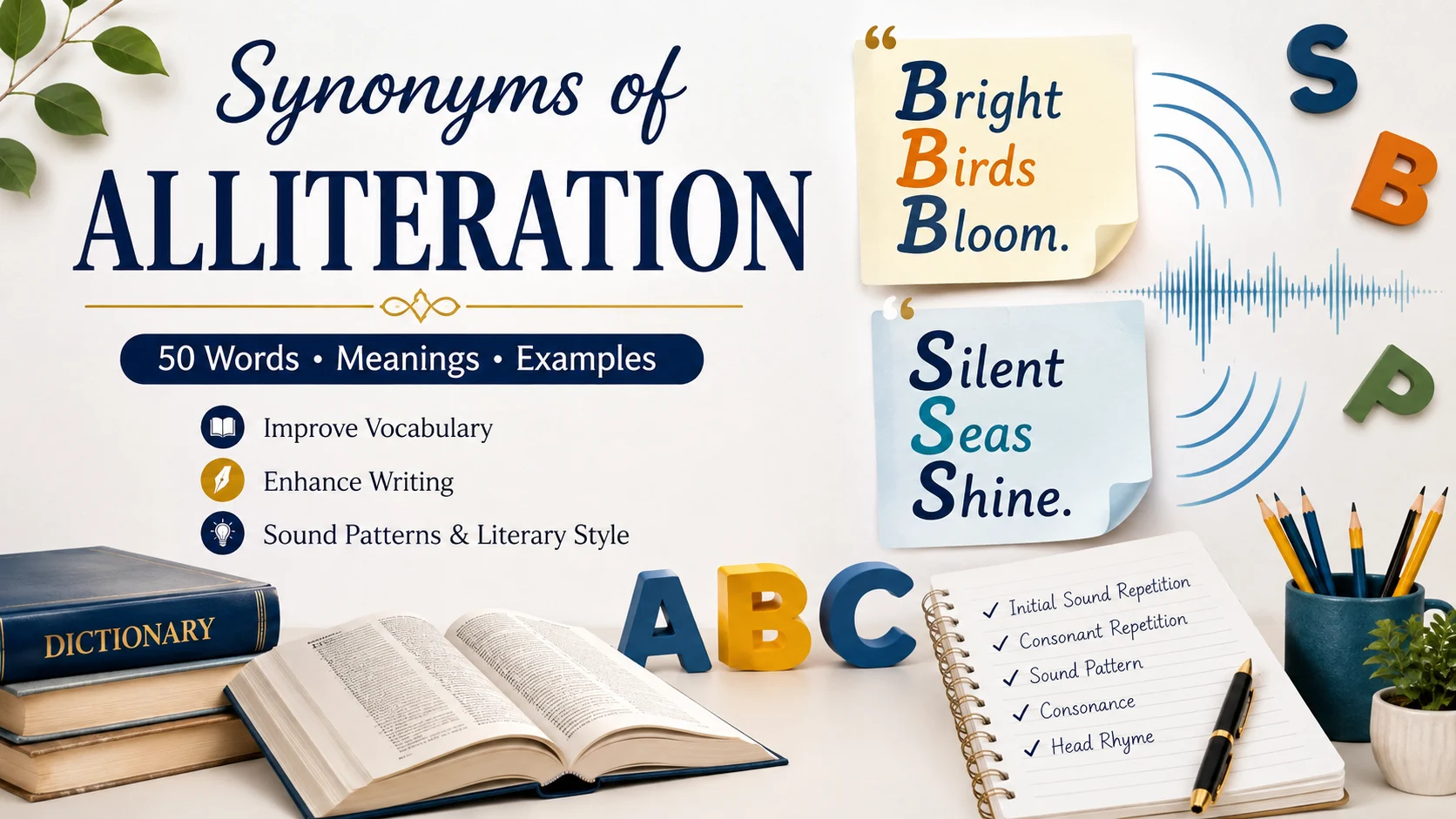
Quick Answer
Alliteration is repeated initial sounds; related terms include consonance, sound repetition, and initial sound pattern.
Imagine you are writing a poem, speech, story, or catchy brand name and want its words to sound memorable. You may need different ways to describe a repeated sound pattern without using the same term again.
The phrase synonyms of alliteration can be slightly tricky because alliteration is a literary and phonetic technique, so it has few perfect synonyms. Many alternatives are closely related terms that describe repeated sounds, consonants, or other forms of verbal patterning.
Below, you will find 50 useful alternatives, from precise expressions to broader literary terms. Each one includes a short meaning and two natural examples to show how it works in context.
1. Initial Sound Repetition
Short Meaning: Repeating similar sounds at the beginnings of nearby words for a noticeable verbal effect.
Example 1: Silver streams slipped softly through the quiet valley.
Example 2: The slogan uses initial sound repetition to make the brand memorable.
2. Initial Consonant Repetition
Short Meaning: Repeating consonant sounds at the beginnings of several words in a phrase.
Example 1: Bright blue birds brought beauty to the garden.
Example 2: The poet relies on initial consonant repetition for a musical effect.
3. Consonant Repetition
Short Meaning: Reusing consonant sounds to create rhythm, emphasis, or a pleasing verbal pattern.
Example 1: Clever cats climbed the tall wooden fence.
Example 2: Consonant repetition gives the advertisement a stronger sound.
4. Head Rhyme
Short Meaning: A traditional poetic term for repeated opening sounds in neighboring words.
Example 1: Wild winds wandered across the winter field.
Example 2: The old poem uses head rhyme to strengthen its rhythm.
5. Initial Rhyme
Short Meaning: Repeated sounds at the beginnings of words, especially in poetic or traditional writing.
Example 1: Deep dreams drifted through the narrator’s thoughts.
Example 2: The teacher explained how initial rhyme can shape a poem.
6. Opening Sound Pattern
Short Meaning: A deliberate arrangement of similar sounds at the start of successive words.
Example 1: Fresh flowers filled the front room.
Example 2: The campaign name has a strong opening sound pattern.
7. Initial Sound Pattern
Short Meaning: A recurring beginning sound used across connected words for style or emphasis.
Example 1: Peter packed pencils before leaving for school.
Example 2: The novelist uses an initial sound pattern in the chapter title.
8. Sound Repetition
Short Meaning: The repeated use of particular sounds to add rhythm, unity, or emphasis.
Example 1: Gentle gardens grew around the old house.
Example 2: Sound repetition makes the children’s rhyme easier to remember.
9. Phonetic Repetition
Short Meaning: Repeating speech sounds to produce a recognizable auditory effect.
Example 1: Tiny turtles traveled toward the water.
Example 2: The researcher noticed phonetic repetition in the spoken advertisement.
10. Phonological Repetition
Short Meaning: Reusing sound features within language to form a deliberate pattern.
Example 1: Busy bees buzzed beside the bright blossoms.
Example 2: Phonological repetition can contribute to rhythm in poetry.
11. Consonantal Recurrence
Short Meaning: The return of similar consonant sounds across words in connected speech or writing.
Example 1: Cold clouds covered the coastal town.
Example 2: Consonantal recurrence gives the sentence a strong verbal texture.
12. Initial Consonance
Short Meaning: A closely related term for recurring consonant sounds near the beginnings of words.
Example 1: Many musicians mention mighty melodies in their interviews.
Example 2: Initial consonance helps create a memorable line for the poster.
13. Sound Echo
Short Meaning: A repeated sound that seems to answer or mirror another sound nearby.
Example 1: Soft songs surrounded the sleeping child.
Example 2: The repeated opening sounds create a clear sound echo.
14. Phonetic Echo
Short Meaning: A recurring speech sound that produces an audible sense of connection.
Example 1: Friendly faces filled the festival entrance.
Example 2: The phrase contains a phonetic echo that improves its flow.
15. Sonic Repetition
Short Meaning: Repeated sounds arranged to create a musical or noticeable verbal impression.
Example 1: Dark doors disappeared into the distance.
Example 2: Sonic repetition gives the speech a memorable quality.
16. Verbal Repetition
Short Meaning: Repeating sounds, words, or structures in language for emphasis and style.
Example 1: Busy builders began before breakfast.
Example 2: The slogan depends on verbal repetition to catch attention.
17. Stylistic Repetition
Short Meaning: Reusing a linguistic feature intentionally to strengthen tone, rhythm, or expression.
Example 1: Red roses rose beside the riverbank.
Example 2: Stylistic repetition can make a title sound more polished.
18. Expressive Repetition
Short Meaning: Repeated language sounds or forms used to add feeling and artistic emphasis.
Example 1: Lonely leaves lingered under the tree.
Example 2: Expressive repetition makes the description feel more dramatic.
19. Literary Sound Device
Short Meaning: A writing technique that uses sound to create rhythm, mood, emphasis, or memorability.
Example 1: The poem uses a literary sound device to create a playful mood.
Example 2: Students studied several literary sound devices during class.
20. Poetic Sound Pattern
Short Meaning: A recurring arrangement of sounds that supports rhythm or musical quality in poetry.
Example 1: Silent seas shimmered beneath the moon.
Example 2: The poet uses a poetic sound pattern to unify the stanza.
21. Prose Sound Pattern
Short Meaning: A deliberate sound arrangement that adds rhythm or style to ordinary written prose.
Example 1: The mayor delivered a bold, balanced message.
Example 2: A prose sound pattern can make an opening paragraph more memorable.
22. Phonological Pattern
Short Meaning: An organized arrangement of speech sounds occurring repeatedly within language.
Example 1: Green grass grew across the hillside.
Example 2: The linguistics lesson examined the phonological pattern in the phrase.
23. Phonetic Pattern
Short Meaning: A noticeable arrangement of actual speech sounds across nearby words.
Example 1: Busy bakers baked fresh bread before sunrise.
Example 2: The speaker created a phonetic pattern that listeners remembered easily.
24. Sonic Pattern
Short Meaning: A recurring arrangement of sounds that gives language a distinctive auditory character.
Example 1: Pale petals painted the garden pink.
Example 2: The song title has a simple sonic pattern.
25. Sound Figure
Short Meaning: A literary figure that gains an expressive effect through carefully arranged sounds.
Example 1: Wild waves welcomed the swimmers.
Example 2: The professor identified the phrase as a sound figure.
26. Verbal Ornament
Short Meaning: A decorative feature of language added to make expression more vivid or memorable.
Example 1: Bright blossoms brought color to the description.
Example 2: The novelist uses verbal ornament without making the sentence difficult.
27. Sound Ornament
Short Meaning: A decorative use of repeated or contrasting sounds within expressive language.
Example 1: Whispering winds wound through the woods.
Example 2: The speech includes sound ornament to create elegance.
28. Phonetic Ornament
Short Meaning: A stylistic use of speech sounds that adds beauty, emphasis, or playfulness.
Example 1: Pretty pink petals covered the table.
Example 2: Phonetic ornament is common in playful advertising language.
29. Rhetorical Sound Device
Short Meaning: A sound based technique used in speech or writing to influence attention and expression.
Example 1: Fearful footsteps filled the fictional hallway.
Example 2: The speaker uses a rhetorical sound device for extra emphasis.
30. Stylistic Sound Device
Short Meaning: A language technique that shapes sound for rhythm, mood, emphasis, or artistic effect.
Example 1: Clever children created colorful cards.
Example 2: The editor removed one stylistic sound device to simplify the sentence.
31. Musical Language
Short Meaning: Language arranged with pleasing rhythm, repeated sounds, or flowing verbal movement.
Example 1: Soft silver songs floated through the theater.
Example 2: The author uses musical language in the opening paragraph.
32. Verbal Musicality
Short Meaning: The pleasing rhythm and sound quality created by carefully chosen words.
Example 1: Gentle voices guided the visitors inside.
Example 2: Verbal musicality can make a speech easier to remember.
33. Euphonic Pattern
Short Meaning: A sound arrangement designed to produce smooth, pleasant, or harmonious speech.
Example 1: Lovely lilies lined the lake.
Example 2: The poem follows an euphonic pattern that suits its peaceful mood.
34. Euphony
Short Meaning: Pleasant sounding language created through harmonious combinations of speech sounds.
Example 1: The calm poem is full of gentle euphony.
Example 2: Euphony can improve the appeal of a brand name.
35. Consonance
Short Meaning: Repetition of consonant sounds, often within or near several words.
Example 1: The phrase shows consonance through repeated soft sounds.
Example 2: Consonance can occur without matching the exact beginnings of words.
36. Assonance
Short Meaning: Repetition of vowel sounds in nearby words, creating an audible connection.
Example 1: The slow road rolled toward the coast.
Example 2: Assonance gives the sentence a smooth internal rhythm.
37. Rhyme
Short Meaning: Similarity between sounds, especially at word endings, often used in poetry.
Example 1: Light and night form a familiar rhyme.
Example 2: The nursery verse uses rhyme to support its playful beat.
38. Sound Recurrence
Short Meaning: The repeated appearance of similar sounds within connected language.
Example 1: Tiny trains traveled through the tunnel.
Example 2: Sound recurrence makes the announcement easier to recall.
39. Recurrent Sound Pattern
Short Meaning: A sound arrangement that returns several times within a phrase or passage.
Example 1: Bright birds bounced between branches.
Example 2: The poem contains a recurrent sound pattern throughout the final stanza.
40. Initial Phoneme Repetition
Short Meaning: Repetition of the same or similar first phoneme across nearby words.
Example 1: Fine foxes followed the forest trail.
Example 2: Initial phoneme repetition is especially noticeable when the opening sounds match closely.
41. Word Initial Repetition
Short Meaning: Repeated sounds or letters appearing at the beginnings of successive words.
Example 1: Big brown bears crossed the path.
Example 2: Word initial repetition gives the headline a catchy quality.
42. Opening Consonant Pattern
Short Meaning: A recurring consonant arrangement appearing at the starts of related words.
Example 1: Fresh fruit filled the market stall.
Example 2: The designer chose an opening consonant pattern for the product name.
43. Consonant Sound Pattern
Short Meaning: A recurring arrangement of consonant sounds that shapes how a phrase is heard.
Example 1: Small stars sparkled above the city.
Example 2: The narrator uses a consonant sound pattern to add tension.
44. Sound Parallelism
Short Meaning: Similar sound structures placed together to create balance, rhythm, or emphasis.
Example 1: Strong minds make meaningful choices.
Example 2: Sound parallelism gives the speech a balanced cadence.
45. Phonological Parallelism
Short Meaning: Similar sound structures repeated across neighboring words or phrases.
Example 1: Wise words won widespread praise.
Example 2: Phonological parallelism strengthens the rhythm of the campaign phrase.
46. Acoustic Pattern
Short Meaning: A repeated sound arrangement that becomes noticeable when language is spoken aloud.
Example 1: Deep drums drove the dancers forward.
Example 2: The speech has an acoustic pattern that sounds powerful aloud.
47. Sound Texture
Short Meaning: The overall quality created by the combination and repetition of sounds in language.
Example 1: Crisp, clean consonants give the poem a lively sound texture.
Example 2: Sound texture matters when writing dialogue for performance.
48. Verbal Patterning
Short Meaning: Deliberate arrangement of words or sounds to create unity, rhythm, or emphasis.
Example 1: Bold builders became the centerpiece of the poster.
Example 2: Verbal patterning helps organize language in memorable slogans.
49. Ornamental Language
Short Meaning: Decorative wording chosen to make expression more vivid, graceful, rhythmic, or striking.
Example 1: Shimmering stars surrounded the silent village.
Example 2: Ornamental language works well in some forms of creative writing.
50. Figurative Sound Pattern
Short Meaning: A purposeful sound arrangement used as part of expressive or literary language.
Example 1: Fierce flames flashed across the fantasy scene.
Example 2: The teacher identified the figurative sound pattern in the opening line.
Short Quiz
1: What does alliteration mainly involve?
A. Repeating vowel meanings
B. Bouncing beginning sounds
C. Repeating paragraph lengths
D. Repeating sentence topics
2: Which alternative best fits a sentence describing repeated consonant sounds at the beginnings of words?
A. Assonance
B. Rhyme
C. Initial consonant repetition
D. Euphony
3: Which term is most closely associated with repeated vowel sounds?
A. Assonance
B. Head rhyme
C. Initial rhyme
D. Word initial repetition
4: Which choice would be most suitable in a formal linguistics discussion?
A. Sound echo
B. Phonological repetition
C. Musical language
D. Verbal ornament
5: A slogan uses repeated opening sounds to become more memorable; which term fits best?
A. Opening sound pattern
B. Rhyme
C. Acoustic pattern
D. Euphony
Quiz Answers
B. Alliteration primarily involves repeated initial sounds in nearby words.
C. Initial consonant repetition directly identifies recurring consonant sounds at word beginnings.
A. Assonance focuses on repeated vowel sounds rather than opening consonants.
B. Phonological repetition suits a formal discussion of recurring speech sounds.
A. Opening sound pattern clearly describes repeated beginning sounds in a slogan.
Frequently Asked Questions
1: What is the best synonym for alliteration?
The closest general alternative is initial sound repetition.
2: What does alliteration mean in simple English?
It means repeating similar beginning sounds in nearby words.
3: What is a formal alternative to alliteration?
Initial consonant repetition is a clear formal expression in linguistic writing.
4: Can alliteration describe objects and situations?
It describes language used to present objects, actions, ideas, or situations in a patterned way.
5: What is the opposite of alliteration?
There is no exact opposite because it is a specific sound technique rather than a quality with a direct antonym.
Conclusion
Choosing among synonyms of alliteration depends on what you are describing and how precise your wording needs to be. Some alternatives focus specifically on repeated opening consonants, while others describe broader sound patterns, literary techniques, or pleasing language.
For academic writing, technical expressions can provide greater Explore 50 synonyms of alliteration with short meanings and natural examples to help students, writers, teachers, and English learners choose better wording. In creative work, broader terms may better capture rhythm, musicality, or decorative sound. The best choice always depends on context, tone, and the exact feature you want to highlight.

Jackson Turner is an American writer who contributes educational and informative articles to SynonymCraft.com. He focuses on English vocabulary, synonyms, grammar, spelling, and word usage, helping readers understand language concepts in a simple and practical way. Through his clear and reader friendly writing,









